

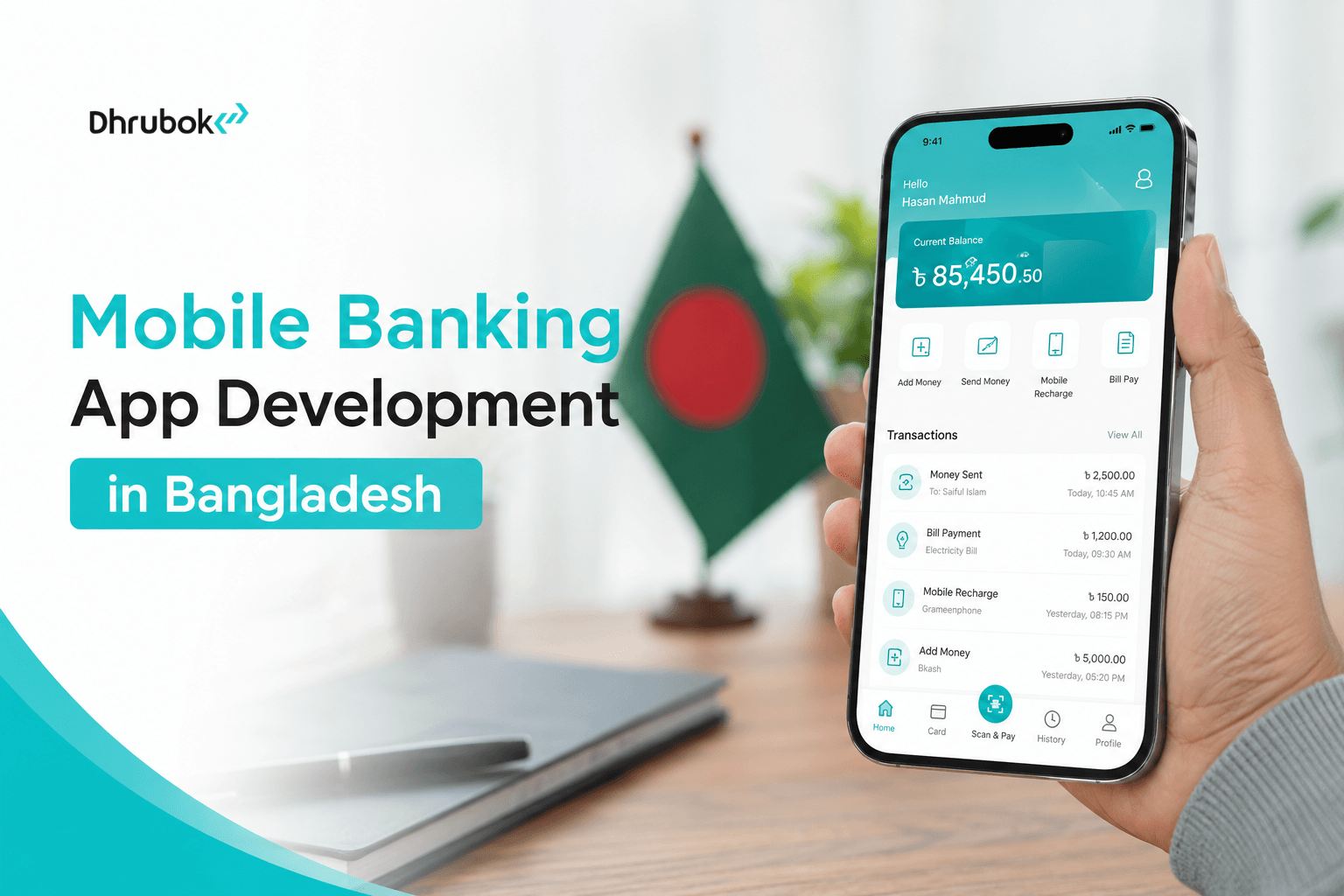



Mobile Banking App Development in Bangladesh
TL; DR: Bangladesh Bank spent the last twelve months rewriting the rules under mobile banking apps — the digital bank capital requirement tripled to BDT 300 crore, new license approvals got paused in February 2026, and fresh e-KYC and e-loan circulars landed mid-year. Before you brief a developer, you need to know which of three tracks you're actually building on: MFS wallet integration, a digital channel for an existing licensed bank, or a ground-up digital bank. Each one has a different cost, timeline, and compliance load — and most founders pick the wrong one before they've even opened a design tool.
Somebody calls us roughly every quarter wanting to "build the next bKash." They've got a deck, a rough feature list, sometimes a Figma file. What they almost never have is an answer to the one question that determines everything else about the project: are you building a wallet, a bank channel, or a bank?
That question used to be a formality. In 2026, it's the whole ballgame. Bangladesh Bank has been unusually active this year — tightening digital bank capital rules, pausing a licensing round mid-review, updating e-KYC, and opening the door to fully digital lending. Spec your app before you've mapped it against these rules, and you'll either overbuild for a wallet you don't need to own or underbuild for a bank you're legally not allowed to operate.
This isn't a features-and-wireframes post. It's the decision framework we walk clients through before a single screen gets designed.
1. The Three Tracks: Which One Are You Actually Building?
Almost every "mobile banking app" idea in Bangladesh falls into one of three buckets. Figuring out which one you're in should happen in week one, not month six.
Track A: MFS Wallet Integration
You're not moving money on your own balance sheet — you're building on top of an existing Mobile Financial Services provider's API (bKash, Nagad, Rocket, or a bank-led MFS platform). This is the fastest, cheapest path to a live product, and it's how most fintech apps in Bangladesh actually launch. You don't need your own BB license; you need a solid integration agreement and compliance with the provider's API terms, plus general ICT security expectations.
Track B: Digital Channel for a Licensed Bank or NBFI
You (or your client) already hold a banking or NBFI license, or you're partnering with one, and you're building the mobile front-end — the app customers use to check balances, transfer funds, apply for e-loans, or open deposit products. This is where most of the serious commercial work in Bangladesh's mobile banking space actually sits right now, because banks are under real pressure to modernize their digital channels.
Track C: Ground-Up Digital Bank
You want to be the licensed entity — a fully branchless bank with no physical presence, governed the same way a traditional bank is, but delivered entirely through mobile and digital channels. This is the track everyone dreams about, and almost nobody should actually pursue without deep capital and a multi-year runway.
Most founders who say they want Track C actually need Track A. The dream is owning the license. The business case, nine times out of ten, is owning the customer experience.
| Track | Governing Framework | Capital / License Bar | Typical Dev Timeline | Best Fit For |
|---|---|---|---|---|
| A: MFS Wallet Integration | Payment and Settlement Systems Act, 2024 (via provider's PSP license) | No license needed — integration agreement only | 3–5 months | Startups, SMEs adding payments, merchant apps |
| B: Bank/NBFI Digital Channel | Bank Company Act, 1991 + BB ICT Security Guideline | Requires existing bank/NBFI license or formal partnership | 6–12 months | Banks, NBFIs modernizing their app |
| C: Licensed Digital Bank | Bank Company Act, 1991 + Digital Bank Guidelines (Version 2) | BDT 300 crore paid-up capital | Multi-year program, not a dev sprint | Well-capitalized consortiums, telecom/MFS incumbents |
2. What Actually Changed in Bangladesh's Regulatory Landscape in 2026
If you scoped this project even eighteen months ago, some of what you knew is now out of date. Here's what's different heading into the second half of 2026.
The Digital Bank Capital Bar More Than Doubled
In August 2025, Bangladesh Bank issued Version 2 of its Digital Bank Guidelines, raising the required paid-up capital from BDT 125 crore to BDT 300 crore and tightening fit-and-proper and shell-company rules for applicants. That's not a rounding change — it roughly triples the entry cost of Track C and was clearly designed to filter out under-capitalized applicants after the earlier round drew criticism for being too permissive.
A Fresh Application Window Opened — and 12 Serious Players Applied
A new application window under the revised guidelines ran from September 1 to November 2, 2025, and twelve domestic and foreign entities submitted applications, including consortiums backed by major telecom operators, MFS incumbents, and conglomerates. That's a strong signal of who's serious about Track C — and it's a useful competitive map if you're evaluating whether that space is already crowded for your niche.
Then, in February 2026, Bangladesh Bank Hit the Brakes
This is the part most competing content on this topic completely misses. On February 16, 2026, Bangladesh Bank's board reviewed the progress of its digital bank licensing initiative but did not grant primary approval to any applicants, following protests from a group of BB officials over the pace of the process. The central bank's spokesperson was clear that the matter had not yet reached the approval stage. If you're planning around a fast Track C license, plan around uncertainty instead — the timeline for new digital bank licenses is currently unpredictable, not just long.
Supervision Is Getting More Real-Time
Bangladesh Bank has been rolling out Risk-Based Supervision (RBS) across scheduled banks, with full implementation slated for January 2026, restructuring the central bank's supervision departments and creating a unified supervisory dashboard for data-driven, real-time monitoring. Practically, this means any app on Track B or C needs to be built with clean, structured, exportable transaction and risk data from day one — retrofitting reporting infrastructure later is expensive.
e-KYC and Fully Digital Lending Just Got Formal Rules
Bangladesh Bank issued updated Guidelines on Electronic Know-Your-Customer (e-KYC) in March 2026. Then, in May 2026, the central bank went further: customers can now apply for loans, get approved, and receive funds entirely online through mobile apps or bank websites, with no branch visit required. The catch — and it's a real one for anyone building a lending feature — is that banks must verify identity using NID checks and biometric authentication, and must pull the applicant's Credit Information Bureau (CIB) report before approving any e-loan, with defaulters automatically excluded. If your app roadmap includes lending, this circular is now the baseline spec, not a future enhancement.
3. Where Decision-Makers Get This Wrong
We see the same three mistakes on repeat, almost always from founders and product leads who are experienced with app development in general but new to Bangladesh's specific regulatory texture.
Mistake 1: Designing the UI Before Confirming the License Track
Feature lists and screen flows differ enormously between a wallet app and a bank digital channel. Building screens before the track is locked means redoing core information architecture once compliance requirements surface — usually around month three, right when the client is most eager to launch.
Mistake 2: Treating MFS API Integration Like a Generic Payment Gateway
Integrating with bKash or Nagad isn't like plugging in Stripe. MFS integrations in Bangladesh carry agent-network reconciliation logic, settlement timing quirks, and provider-specific security requirements that a developer without local MFS experience will underestimate — often badly.
Mistake 3: Ignoring ICT Security and Data Residency Requirements Until the Security Audit
Bangladesh Bank's ICT security expectations for banks and NBFIs cover things like disaster recovery infrastructure and controlled data hosting. Teams that build first and retrofit compliance later routinely fail their first security review — costing weeks they didn't budget for.
4. What a Compliant Mobile Banking App Actually Needs Under the Hood
- NID and biometric identity verification — now a baseline expectation for onboarding and e-loan approval, not a nice-to-have
- CIB integration — required before approving any digital lending product
- Encrypted, auditable transaction layer — with clean data structures that can feed BB's move toward real-time supervisory reporting
- PSS Act 2024–compliant payment rails — if you're touching payment processing directly rather than through an existing provider
- Own or contracted disaster recovery infrastructure — a recurring gap flagged in governance reviews of smaller MFS providers who relied entirely on a parent bank's servers
- An interoperability layer — most successful apps in this space don't try to replace bKash or Nagad; they sit alongside them, because customers already have MFS habits that are extremely hard to displace
5. Cost and Timeline Factors in the Bangladesh Market
The single biggest cost driver isn't screen count — it's compliance depth. Here's roughly how the three tracks compare when clients ask us to scope them side by side.
| Factor | Track A: MFS Wallet | Track B: Bank Digital Channel | Track C: Digital Bank |
|---|---|---|---|
| Primary cost driver | Feature scope, UX polish | Core banking integration, security audit | Core infrastructure, compliance staffing, licensing engagement |
| Compliance overhead | Low — provider handles most of it | Moderate–high — BB ICT guideline, e-KYC, reporting | Very high — full bank-grade governance |
| Realistic MVP timeline | 3–5 months | 6–12 months | Multi-year program |
| Who typically builds this | Local dev agency | Specialized fintech dev partner + compliance consultant | In-house team + dev partner + legal/regulatory advisors |
6. A Compliance Checklist Worth Reviewing Before You Sign a Dev Contract
- Have you confirmed which track (A, B, or C) your product actually requires — in writing, not assumption?
- If Track A, does your integration agreement with the MFS provider cover settlement timing and dispute handling?
- If Track B or C, does your architecture plan account for Bangladesh Bank's ICT Security Guideline requirements, including disaster recovery?
- If your app includes any lending feature, is CIB report retrieval and NID/biometric verification built into the approval flow — not bolted on later?
- Is your transaction data structured in a way that could feed a supervisory reporting dashboard without a rebuild?
- Has your development partner actually shipped something for a licensed bank, NBFI, or MFS integration in Bangladesh before — or is this their first?
7. Choosing a Development Partner for This Kind of Build
Generic app development experience doesn't transfer cleanly here. Before you sign anything, ask a prospective partner:
- Can you show a live product you've built on an MFS integration, not just a mockup?
- Do you have direct experience with Bangladesh Bank's ICT Security Guideline audit process?
- How do you handle circular updates — like the March 2026 e-KYC guidance or the May 2026 e-loan rules — once the app is already live?
- What's your actual role if my licensing track changes mid-project — can you adapt the architecture, or does it mean starting over?
That last question filters out more agencies than any other. A team that only knows how to build features can't tell you when your feature list conflicts with a Bangladesh Bank circular. A team that's actually shipped in this space will flag it before you spend a single sprint on it.
Frequently Asked Questions
How much does it cost to build a mobile banking app in Bangladesh?
It depends entirely on which track you're building for. An MFS-integrated wallet app typically runs from a few thousand dollars for a lean MVP to the low six figures for a full-featured product with a local development partner. A digital channel app for an existing licensed bank or NBFI usually costs more once you factor in core banking integration, security audits, and Bangladesh Bank ICT compliance — often well into six figures. A ground-up digital bank build is a different category entirely: you're funding core banking infrastructure, a compliance team, and years of regulatory engagement before the BDT 300 crore capital requirement even enters the picture. Get a scoped quote once your track is decided — not before.
Do I need a Bangladesh Bank license to launch a banking app?
Only if you're operating as the licensed entity holding customer funds directly. If you're integrating with an existing MFS provider's API (bKash, Nagad, Rocket) or building the mobile front-end for a bank or NBFI that already holds a banking or MFS license, you don't need your own license — you need a partnership or integration agreement, plus compliance with Bangladesh Bank's ICT Security Guideline. You only need your own license if you intend to operate as a Payment Service Provider, Payment System Operator, or Digital Bank in your own right.
What's the difference between an MFS app and a digital bank app?
An MFS app is a mobile wallet built on a Payment Service Provider license under the Payment and Settlement Systems Act, 2024 — it moves money but generally can't offer full banking products like interest-bearing accounts or unrestricted lending on its own balance sheet. A digital bank is a fully licensed, branchless bank under the Bank Company Act, 1991, with no physical branches, its own balance sheet, and the same governance obligations as a traditional bank — plus a much higher capital bar and a mandatory IPO within five years of licensing.
How long does mobile banking app development take in Bangladesh?
An MFS-integrated app can realistically go from kickoff to a compliant MVP in three to five months. A digital channel app for a licensed bank or NBFI usually takes six to twelve months once you include security audits and BB reporting integration. A licensed digital bank build isn't really a development timeline at all — it's a multi-year program, since the licensing process itself, including board review and letter-of-intent stages, has historically taken well over a year even for well-capitalized applicants.
Can a foreign company build a mobile banking app for the Bangladesh market?
Yes, foreign development partners build for the Bangladesh market regularly, but the entity holding the license — whether MFS, PSP, or digital bank — must meet Bangladesh Bank's local incorporation, capital, and governance requirements. It's common and often more efficient for foreign or diaspora-backed founders to pair with a Bangladesh-based development partner who already understands BB's ICT security guidelines, e-KYC requirements, and reporting formats, rather than trying to interpret central bank circulars from abroad.
Where This Leaves You
2026 didn't make mobile banking app development in Bangladesh harder — it made it more specific. The capital bar for Track C tripled. The licensing process for new digital banks stalled mid-review. e-KYC and e-loan rules got formalized. None of that closes the opportunity; it just means the founders who win this year are the ones who pick the right track before they write a single line of code, not after.
If you're still not sure whether your idea is a Track A integration, a Track B channel, or a Track C license play, that's exactly the conversation worth having before you brief a developer. Book a consultation with our team and we'll map your idea against Bangladesh Bank's current framework, tell you honestly which track fits your budget and timeline, and scope what it actually takes to build it right the first time.