

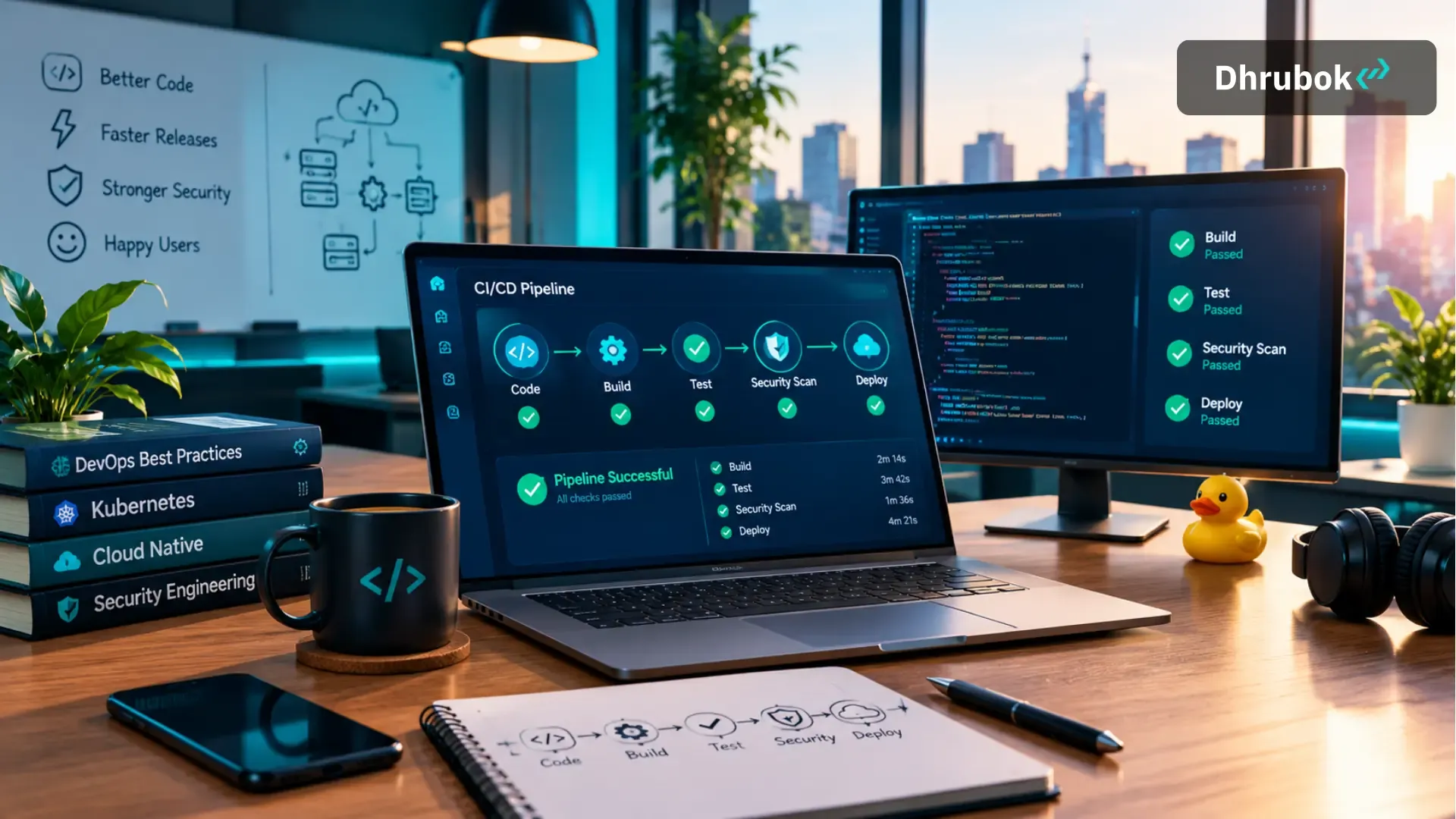



DevSecOps means folding security checks into every stage of your CI/CD pipeline instead of testing for vulnerabilities right before launch. "Security at the end" fails because by the time a pen test finds a flaw, it's already wired into your database schema, your API contracts, and your production traffic — which makes it expensive and risky to fix. For a startup, DevSecOps has to be embedded at three points: the design stage (threat modeling before a line of code is written), the build stage (automated scanning inside CI/CD), and the release stage (pre-deploy testing and least-privilege access controls). Get those three right, and you spend a few extra hours per sprint instead of a few weeks and a PR crisis after a breach.
The 2 AM Phone Call Every Founder Dreads
Picture a fairly typical Dhaka fintech startup. Twelve people, a mobile wallet app, six months of runway, and a board that wants the MVP live before the next funding round conversation. The engineering team — mostly contract developers hired to hit the deadline — ships fast. Security review gets pushed to "after we validate product-market fit." Nobody disables the debug endpoint that logs full request payloads, including auth tokens, to a public-facing log viewer. Nobody rotates the API key that got pasted into a shared Slack channel three sprints ago.
Four months post-launch, a researcher — or worse, an attacker — finds the exposed endpoint. Customer phone numbers, partial transaction histories, and session tokens for several thousand users leak. The founder gets the call at 2 AM. What follows isn't just an engineering fire drill: it's an emergency legal review, a Bangladesh Bank disclosure obligation if the product touches payments, a scramble to notify affected users, and a rebuild of the authentication layer under pressure while the press asks questions.
The fix that would have taken an afternoon during development now takes weeks, involves lawyers, and costs a multiple of what prevention would have. This is not a hypothetical scare story — it's the default outcome when security is treated as a final checkbox instead of a design constraint. And it's exactly why the smartest way to think about DevSecOps isn't as overhead that slows delivery. It's insurance you pay for in small, cheap installments instead of one catastrophic lump sum.
1. What DevSecOps Actually Means (Beyond the Buzzword)
DevSecOps gets thrown around as a marketing term almost as often as "AI-powered." Stripped of the buzz, it's a fairly simple idea: security responsibilities move from being a separate team's job at the end of the pipeline to being a shared responsibility built into every stage of the CI/CD pipeline — code commit, build, test, and deploy.
The traditional model looked like this: developers write code, QA tests functionality, and — right before release — a security team (internal or a hired third party) runs a penetration test or audit. If they find something, it goes back to engineering as a fire alarm, usually days before a planned launch. This model made a certain kind of sense when release cycles were measured in months. It makes almost no sense in 2026, when AI is embedded across every stage of the software development lifecycle, from code generation to deployment, and code changes daily rather than quarterly.
DevSecOps replaces the single "gate" with continuous, automated checks at every commit and every pipeline run: static code analysis when a developer pushes code, dependency scanning when a package is added, secrets detection before a merge, and dynamic testing before a deploy goes live. Industry data backs up why this shift matters — cloud-native applications now make up roughly 48% of the DevSecOps market, and secure CI/CD pipeline automation is the single largest use case within it. In plain terms: security is no longer a separate stage bolted onto delivery. It's becoming part of delivery itself.
Security folded into your pipeline costs you minutes per build. Security discovered by an attacker costs you your customers' trust — and possibly your banking license.
There's a second, newer wrinkle worth naming directly: a growing share of code in any startup's repository today wasn't written entirely by a human. More than seventy percent of enterprise codebases already include components created with AI assistance, which has expanded both the volume and unpredictability of changes flowing into production. If your review process still assumes every line was typed and understood by a person on your team, you're already behind. DevSecOps in 2026 has to account for AI-generated code carrying the same scrutiny as human-written code — arguably more, since nobody on your team may have read it line by line.
2. Why Bangladeshi Startups Are Especially Exposed
Three forces converge to make Bangladeshi startups a softer target than their funding size would suggest.
First, MVP timelines are brutally compressed. Local seed and pre-seed rounds are small relative to global benchmarks, which means founders push for the fastest possible path to a demo-able product. Security review is the easiest thing to defer when a demo day or an investor call is three weeks away — it produces no visible feature, and skipping it doesn't break the demo.
Second, outsourced and contract-heavy development cycles create ownership gaps. It's common for a Bangladeshi startup to bring in a freelance developer or a rotating cast of contract engineers to hit a deadline, then have that team disband once the milestone is delivered. Nobody owns the codebase's long-term security posture. Access credentials, admin panels, and third-party API keys issued to a contractor six months ago often outlive the contractor's involvement — a textbook access-control failure that costs nothing to prevent and everything to clean up after the fact.
Third, the threat landscape itself has shifted toward automation and AI. Attackers no longer need to manually probe for weak endpoints — AI-assisted reconnaissance tools do it at scale, cheaply, against thousands of targets simultaneously. The financial sector, globally, is a prime target: banking institutions face an estimated 630 cyberattacks daily on average, and Bangladesh's own history includes the infamous $101 million Bangladesh Bank SWIFT heist, still studied a decade later as a case study in how a single unpatched gap can cascade into catastrophic loss. More recently, a 2023 breach of Bangladeshi government infrastructure exposed the personal data of more than 50 million citizens, including national ID numbers — a breach that resulted not from a deliberate hack but from weaknesses in infrastructure and data protection practices that a basic security review would likely have caught. That single incident is now cited across the regional cybersecurity industry as one of the most consequential data security failures in South Asian history.
Layer AI-driven attack automation on top of that baseline, and the picture gets sharper still: the average cost of a cyberattack has risen 15% year-over-year across all sectors, with AI cited as both the primary attack accelerant and the most promising defensive tool. For a lean Bangladeshi startup without a dedicated security hire, that means the attackers coming for weak API endpoints and exposed secrets are better resourced than ever — while most startups' defenses haven't changed since the MVP shipped.
3. The 4 Practical DevSecOps Wins for a Lean Team
None of this requires hiring a security team. A five-to-fifteen-person engineering group can implement all four of the following practices inside a single sprint, and most of the tooling below has a genuinely usable free tier.
3.1 Automated Dependency Scanning
Most vulnerabilities in a modern app don't live in code your team wrote — they live in the open-source packages your app depends on. A single outdated library with a known CVE (Common Vulnerabilities and Exposures entry) can expose your entire application, regardless of how clean your own code is. Automated dependency scanning checks every package your project imports against public vulnerability databases, every time you commit.
Tool options: GitHub's built-in Dependabot (free, and already available if your code lives on GitHub) and the OWASP Dependency-Check project (free, open-source) cover the essentials for most teams. If you outgrow those, Snyk's paid tiers add deeper remediation guidance and container-image scanning.
3.2 Secrets Management
API keys, database passwords, and payment gateway credentials pasted into code, config files, or Slack messages are one of the most common — and most preventable — causes of breaches. Secrets management means storing credentials in a dedicated encrypted vault that applications call at runtime, instead of hardcoding them anywhere a human (or a leaked Git commit) can read them.
Tool options: git-secrets (free, scans commits before they happen) paired with HashiCorp Vault's open-source edition covers most startup needs at zero licensing cost. Teams that want a managed, no-infrastructure option often move to Doppler or AWS Secrets Manager as they scale, both of which have startup-friendly pricing tiers.
3.3 Least-Privilege Access
Every contractor, every admin panel login, and every cloud console user should have exactly the access they need to do their job — nothing more. In practice, most startups do the opposite: everyone gets admin rights because it's faster to set up. The problem surfaces the moment a contractor's engagement ends and nobody revokes their access, or a junior developer's compromised laptop suddenly has production database credentials sitting in a config file.
Tool options: Cloud providers' native IAM (Identity and Access Management) consoles — AWS IAM, Google Cloud IAM, Azure AD — are free and sufficient for most startups if configured with role-based access from day one. For teams managing a larger contractor roster, a paid identity platform like Okta or JumpCloud adds centralized offboarding, which is where most access-control failures actually happen.
3.4 Pre-Deploy Security Testing
Before code reaches production, an automated scan should probe the running application the way an attacker would — checking for common issues like SQL injection, broken authentication, and misconfigured headers. This is different from code-level scanning: it tests the live, running behavior of your app, not just the source.
Tool options: OWASP ZAP (free, open-source, and actively maintained) is the standard starting point and integrates into most CI/CD pipelines with a few hours of setup. Paid platforms like Burp Suite Professional or Checkmarx add automation depth and reporting suited to teams handling regulated data, such as mobile banking or MFS (Mobile Financial Services) products.
4. Cost of Retrofitting vs. Building In
The single most persuasive argument for DevSecOps isn't philosophical — it's arithmetic. The relative cost of fixing a defect climbs sharply the later it's caught in the development lifecycle, a pattern security and software engineering teams have documented for decades and that still holds in 2026's AI-accelerated release cycles.
| Stage Where Vulnerability Is Caught | Relative Cost to Fix | Why It Escalates |
|---|---|---|
| Design/threat modeling (pre-code) | 1x (baseline) | Fixing a flawed assumption on a whiteboard or in a design doc costs almost nothing — no code exists yet to unwind. |
| Development (caught by automated scanning) | ~6x | Code exists but hasn't shipped; a developer rewrites a function before it touches other systems. |
| QA / pre-deploy testing | ~15x | The flaw is now woven into integration points, tests, and possibly a staging environment other features depend on. |
| Post-launch / production | ~30–100x | Fixing requires patching live systems without breaking active users, notifying affected customers, possible regulatory disclosure, forensic investigation, and reputational damage control. |
Note: these multipliers are illustrative industry rules of thumb rather than a precise formula — actual cost depends on your architecture, your regulatory exposure, and how much customer data is involved. But the direction of the curve is consistent across every study on the topic, and it only gets steeper for regulated fintech products where a breach triggers Bangladesh Bank disclosure obligations on top of the engineering fix itself.
The lesson isn't "spend more on security." It's "spend earlier." A threat-modeling session before your first sprint costs a few hours of a senior engineer's time. The same gap discovered in production costs weeks of remediation, a potential regulatory filing, and — the part that doesn't show up on a spreadsheet — the trust of every customer who has to decide whether to keep their money in your app.
5. What to Ask Your Development Partner
If you're evaluating an outsourced or agency development partner — which most Bangladeshi startups do at some stage — security practices are rarely volunteered up front. You have to ask. Here's the checklist worth running through before signing a contract:
- "Do you run automated dependency and vulnerability scanning as part of your CI/CD pipeline, or only at project handover?" If scanning happens only once at the end, you're getting an audit, not DevSecOps.
- "How do you manage secrets and API keys across your development team, especially when contractors rotate on and off the project?" A vague answer here is a red flag — this is the single most common source of real-world breaches.
- "What's your process for revoking access when a developer or contractor leaves the project?" Ask for a concrete process, not a promise.
- "Can you show me a sample threat model or security review from a comparable project?" A partner that does this routinely will have an example ready. One that doesn't, won't.
- "Who owns security after launch — is it included in your maintenance/support contract, or a separate engagement?" Security isn't a one-time deliverable; it needs a named owner post-launch.
- "How do you handle AI-generated or AI-assisted code in your review process?" By 2026, this question separates partners who've updated their process from ones running 2022-era workflows.
This is exactly the kind of due diligence Dhrubok Infotech builds into every Enterprise Software Solutions engagement — security review isn't a line item you have to negotiate for; it's embedded in how we scope, build, and hand off every project from day one.
Frequently Asked Questions
Q1: What is DevSecOps in simple terms?
ANS: DevSecOps means building security checks into every stage of software development and deployment, instead of testing for security only at the end. It turns security from a one-time audit into an automated, ongoing part of how code gets written, tested, and shipped.
Q2: Is DevSecOps only for large enterprises?
ANS: No. DevSecOps scales down as well as it scales up. A five-person startup can implement automated dependency scanning, secrets management, and pre-deploy security testing using free or low-cost open-source tools in a single sprint. The practices matter more than the budget behind them.
Q3: How much does it cost to add security into an existing project?
ANS: It depends on how deep the vulnerabilities are baked into the architecture, but retrofitting security after launch typically costs several times more than building it in from the start, because fixes often require re-architecting features, migrating data, or rebuilding authentication flows that are already live and in use. A phased security audit followed by prioritized remediation is usually more affordable than a full rebuild.
Q4: What tools do small teams use for DevSecOps?
ANS: Lean teams commonly start with free or open-source tools such as GitHub Dependabot or OWASP Dependency-Check for dependency scanning, HashiCorp Vault's open-source edition or git-secrets for secrets management, and OWASP ZAP for pre-deploy security testing, upgrading to paid platforms like Snyk, Doppler, or Checkmarx as the codebase and team grow.